
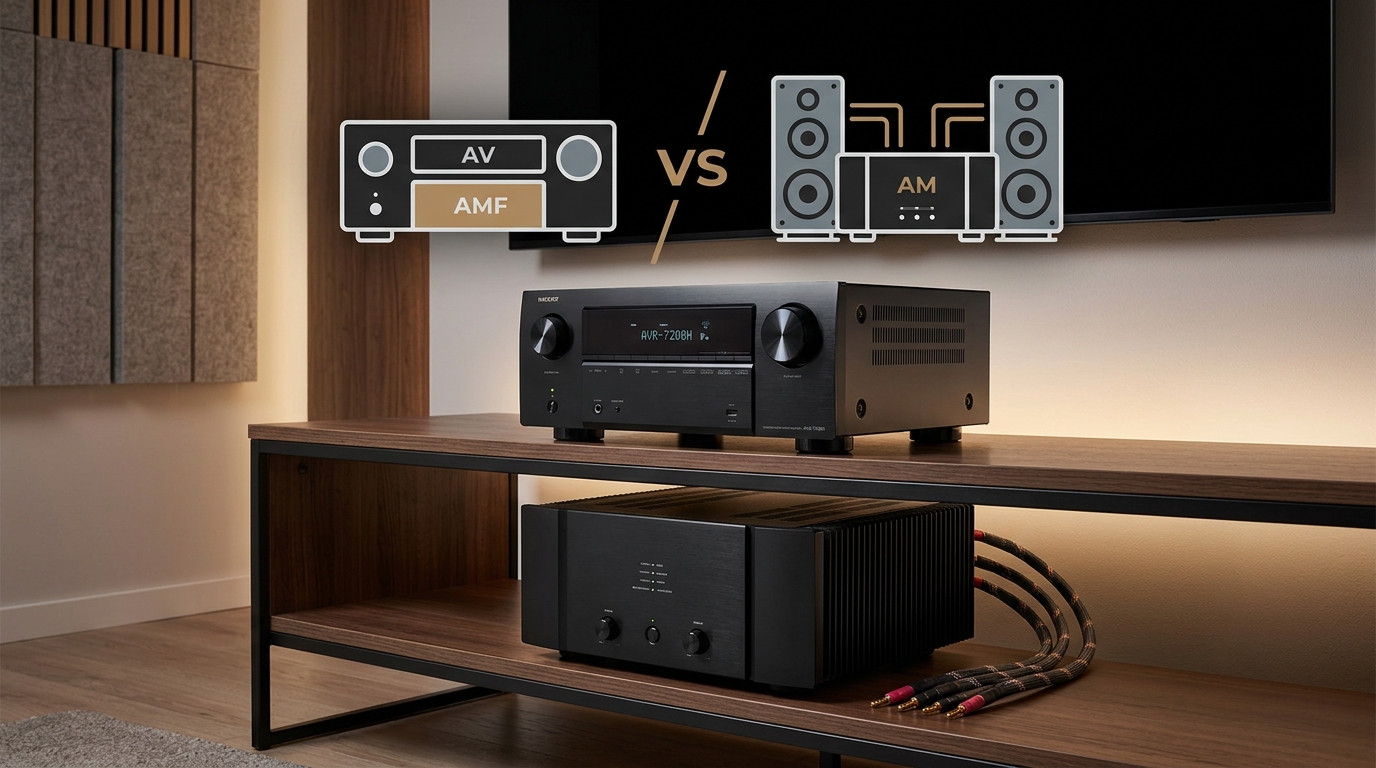
You bought an AV receiver, connected your speakers, and everything sounds pretty good. But then you start reading forum posts about separate power amplifiers and wonder if you’re missing out on better sound. Maybe your receiver runs hot during loud scenes, or someone told you that dedicated amps make a real difference.
The truth is, most people don’t need a separate power amplifier. But some specific situations make adding one worth the investment.
A separate power amplifier becomes necessary when your AVR struggles to drive demanding speakers, runs hot during normal use, or lacks enough channels for your setup. Most mid-range receivers provide adequate power for typical home theater speakers in rooms under 3,000 cubic feet. Add an external amp only when you experience volume limitations, thermal shutdowns, or need to power inefficient speakers rated below 87 dB sensitivity.
Understanding what your receiver actually does
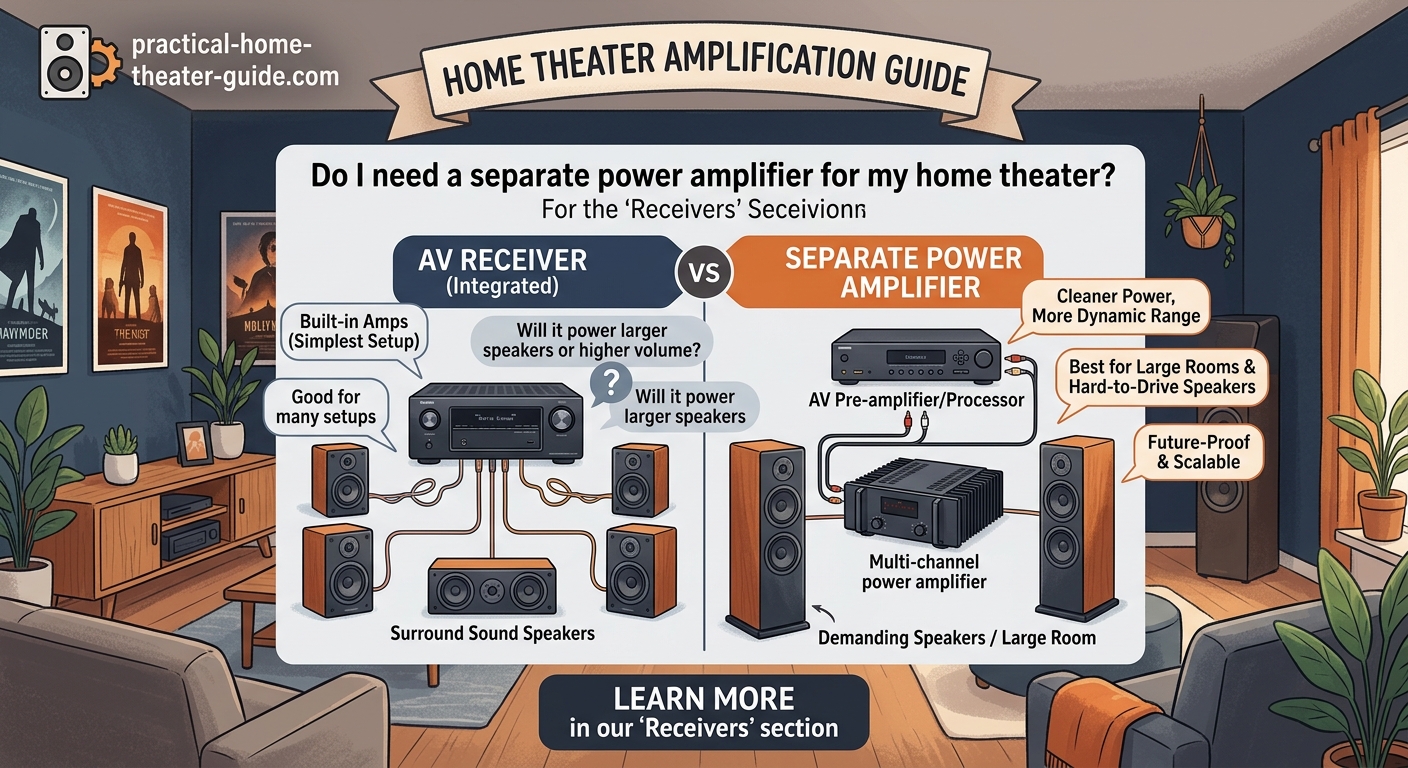
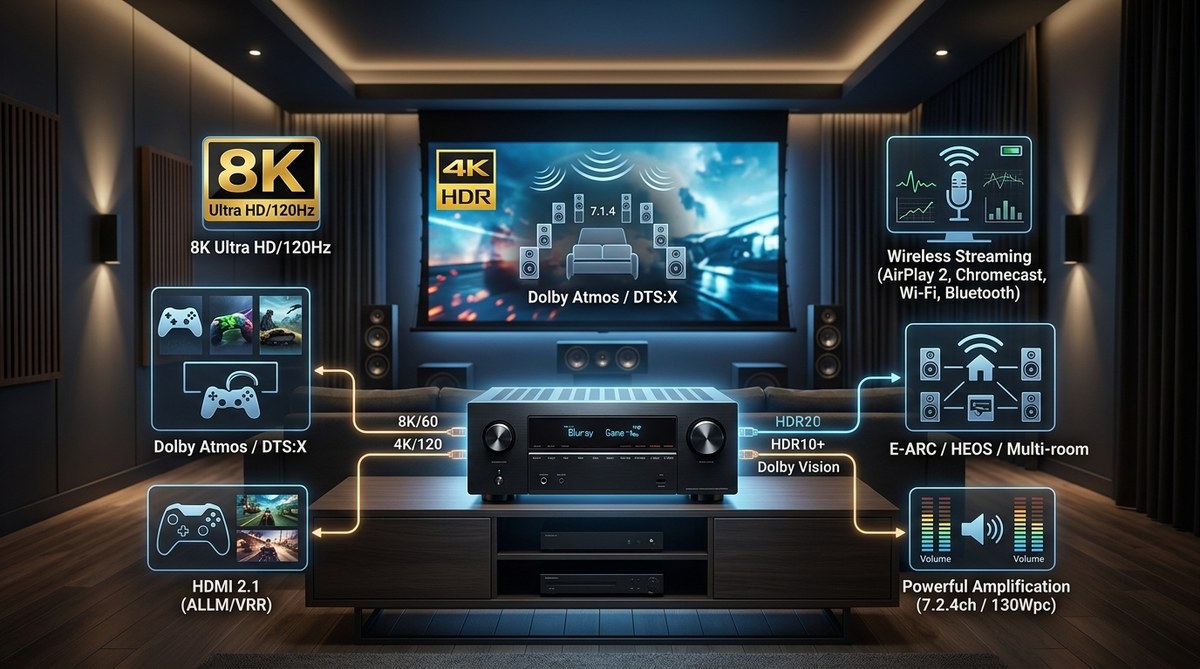
Your AV receiver handles two main jobs. It processes audio signals and video switching through its preamp section. Then it amplifies those audio signals to drive your speakers through its built-in power amplifier section.
A separate power amplifier takes over just that second job. Your receiver still handles all the processing, but sends the audio signal to the external amp instead of using its internal amplifiers.
Think of your receiver as doing double duty. The preamp section is the brain. The power amp section is the muscle. When you add a separate amplifier, you’re giving your system dedicated muscle that doesn’t share resources with the brain.
Most receivers have pre-out connections on the back panel. These outputs send line-level signals to external amplifiers. If your receiver lacks pre-outs, you cannot add a separate power amplifier without replacing the receiver entirely.
Signs you might actually need more power
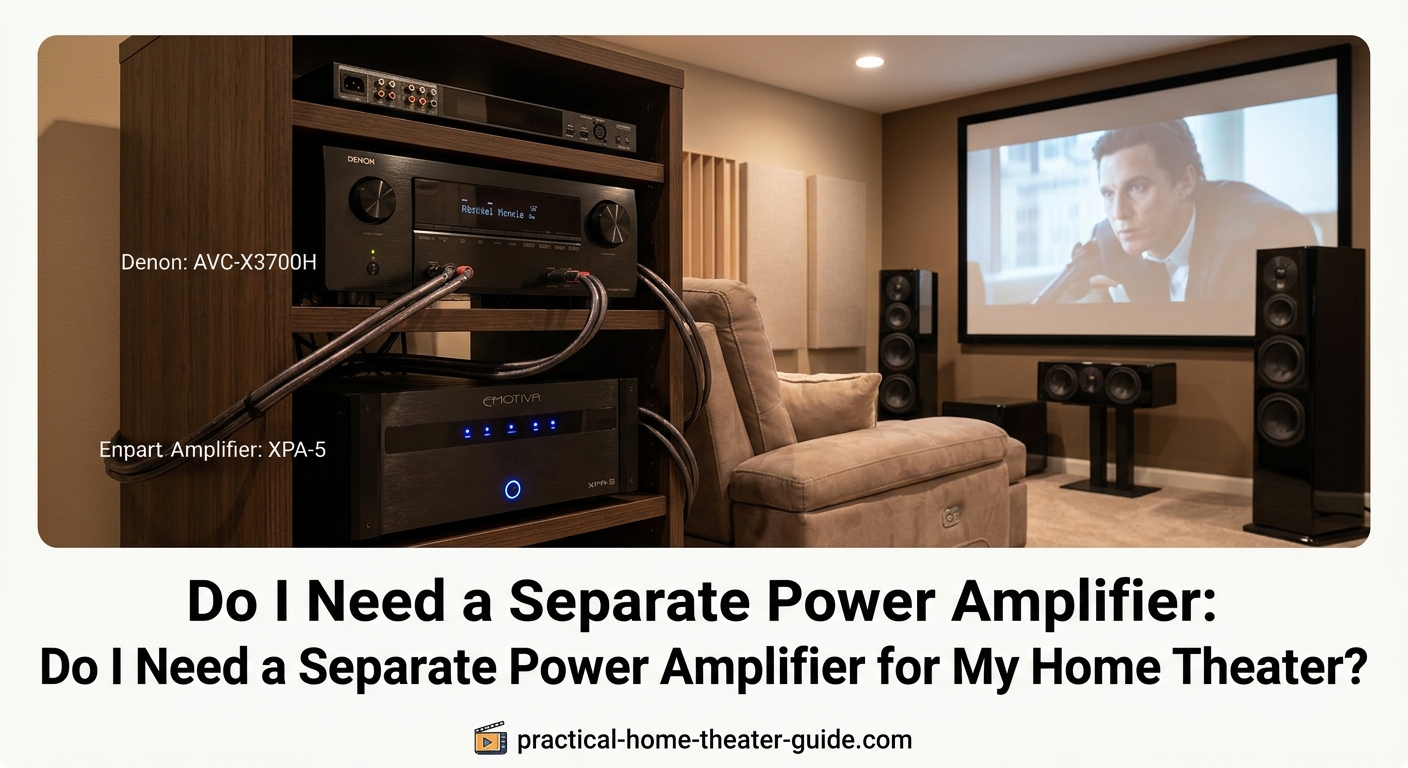
Your receiver gives you clear warnings when it struggles to provide enough power. Recognizing these signs helps you decide if an external amp solves a real problem or just adds expense.
Your receiver shuts down during loud scenes
Thermal protection kicks in when the internal amplifiers generate too much heat. This happens most often with demanding speakers or when you push volume levels high for extended periods.
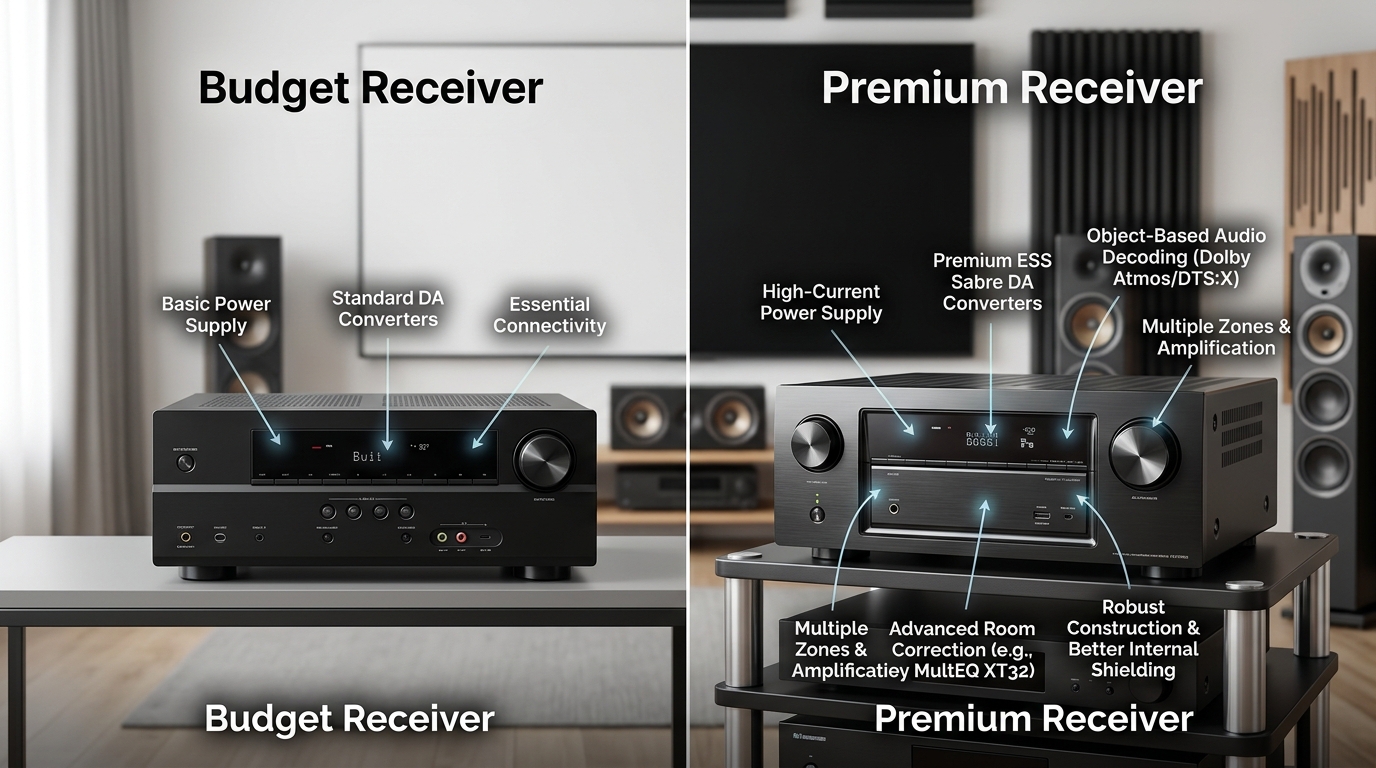
Budget receivers use smaller power supplies and heat sinks. They cannot sustain high output levels without overheating. If your receiver shuts down during action movies or concert footage, it needs help.
Your speakers sound strained at moderate volumes
Speakers require clean power to reproduce dynamics without distortion. When amplifiers run out of headroom, you hear compression, harshness, or a sense that the sound cannot get any louder even when you turn up the volume.
This matters most during peaks. A movie explosion or orchestral crescendo demands sudden bursts of power. Underpowered amplifiers clip the signal, creating audible distortion that sounds harsh and fatiguing.
Your main speakers have low sensitivity ratings
Speaker sensitivity tells you how loud a speaker plays with one watt of power at one meter distance. Speakers rated below 87 dB sensitivity need significantly more power to reach the same volume as more efficient designs.
Tower speakers with multiple drivers often fall into this category. They sound amazing but demand substantial amplification. Pairing them with a mid-range receiver creates a mismatch that limits performance.
When your receiver has enough power already
Most modern receivers deliver plenty of power for typical home theater setups. Understanding when you have enough saves you from unnecessary upgrades.
Receivers rated at 80 to 100 watts per channel handle speakers with 88 dB or higher sensitivity in rooms up to 3,000 cubic feet. That covers most living rooms and dedicated theater spaces under 20 feet long.
Your listening distance matters too. Sitting 10 to 12 feet from your speakers requires far less power than sitting 18 feet away. Sound pressure level drops by 6 dB every time you double the distance. Closer seating means your receiver works less hard to fill the room.
How far should you sit from your screen? affects both picture quality and how much power you need from your amplification.
Efficient bookshelf speakers rated at 89 dB or higher play surprisingly loud with modest power. A 75-watt receiver drives these speakers to reference levels in most rooms without breaking a sweat.
How to calculate if you need more amplification
You can estimate your power needs with a simple calculation. This helps you make an informed decision based on your actual situation rather than marketing claims.
- Measure your room volume in cubic feet by multiplying length times width times height.
- Find your speaker sensitivity rating in the manual or manufacturer specifications.
- Determine your desired peak listening level, typically 95 to 105 dB for home theater reference.
A room measuring 15 x 20 x 8 feet equals 2,400 cubic feet. Speakers rated at 87 dB sensitivity need roughly 100 watts to hit 100 dB peaks at the listening position 12 feet away. Speakers at 90 dB sensitivity need only 50 watts for the same level.
Your receiver’s rated power assumes all channels driven, which rarely happens in real use. During most content, only one or two channels play at high levels simultaneously. This gives your receiver more headroom than the specifications suggest.
Add external amplification only after you confirm your receiver cannot deliver the power you need. Testing with demanding content at your normal listening levels reveals whether you have a real power shortage or just upgrade anxiety.
The difference between more power and better sound
Adding a separate amplifier increases available power, but power alone doesn’t guarantee better sound quality. Understanding what actually improves helps you set realistic expectations.
Doubling your amplifier power from 100 watts to 200 watts increases maximum volume by just 3 dB. That’s barely noticeable. You need ten times the power to double perceived loudness.
Better sound comes from improved dynamic headroom, lower distortion, and reduced stress on your receiver. A dedicated amplifier maintains clean output during peaks without strain. Your receiver runs cooler and processes signals more effectively when it doesn’t share resources with power amplification.
High-quality amplifiers also provide tighter bass control and clearer midrange detail. This happens because they maintain stable output regardless of speaker impedance changes. Speakers present varying loads at different frequencies, and better amplifiers handle these variations without performance degradation.
Which speakers benefit most from external amplification
Not all speakers gain equally from separate amplification. Some designs demand it, while others show minimal improvement.
- Floor-standing towers with multiple woofers
- Planar magnetic or electrostatic speakers
- High-end bookshelf speakers rated below 86 dB sensitivity
- Center channels with complex crossovers
- Any speaker rated at 4 ohms nominal impedance
Compact satellite speakers and most soundbar replacements work fine with receiver power. They’re designed for efficiency and don’t require massive amplification to perform well.
Your center channel speaker positioning matters more than adding power if dialogue sounds unclear. Proper placement often solves perceived power problems.
Common mistakes when adding external amplification
People make predictable errors when adding separate amplifiers to their systems. Avoiding these saves money and frustration.
| Mistake | Why it matters | Better approach |
|---|---|---|
| Buying too much power | Wastes money on capability you’ll never use | Match amp power to speaker handling and room size |
| Amplifying only the fronts | Creates tonal imbalance across channels | Amplify all main speakers or none |
| Ignoring impedance matching | Causes protection circuits to trigger | Verify amp stability at your speaker impedance |
| Skipping receiver pre-outs | Makes external amp connection impossible | Check for pre-out jacks before buying an amp |
| Using inadequate cables | Introduces noise and signal degradation | Use quality balanced XLR or shielded RCA cables |
The most expensive mistake is buying an amplifier before confirming you need one. Test your current setup thoroughly first. Push your receiver hard with demanding content. Note any distortion, thermal shutdowns, or volume limitations.
How to add a power amplifier to your existing setup
Adding external amplification requires proper connections and configuration. Following the correct sequence prevents mistakes and optimizes performance.
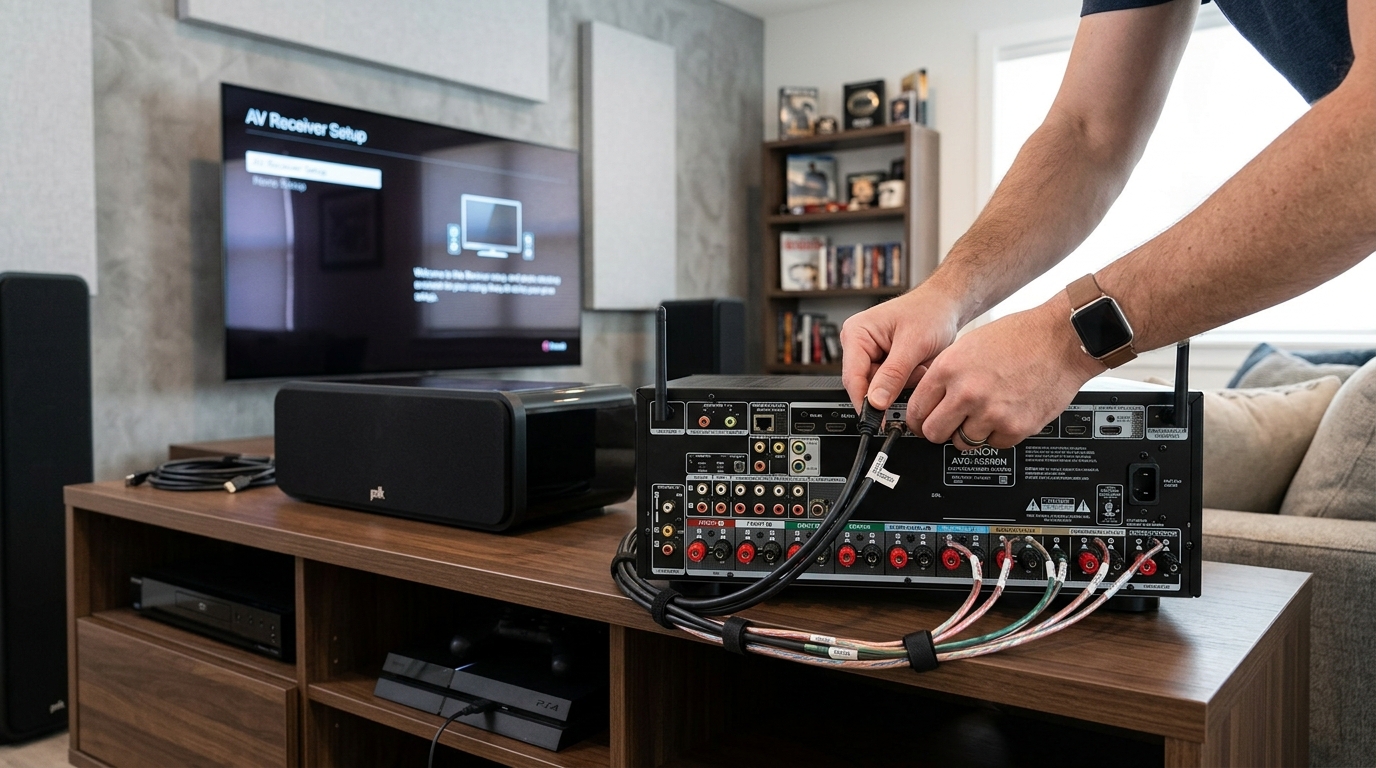
- Confirm your receiver has pre-out connections for the channels you want to amplify.
- Connect RCA or XLR cables from receiver pre-outs to amplifier inputs.
- Run speaker cables from the amplifier outputs to your speakers.
- Access your receiver’s speaker configuration menu and disable internal amplification for externally powered channels.
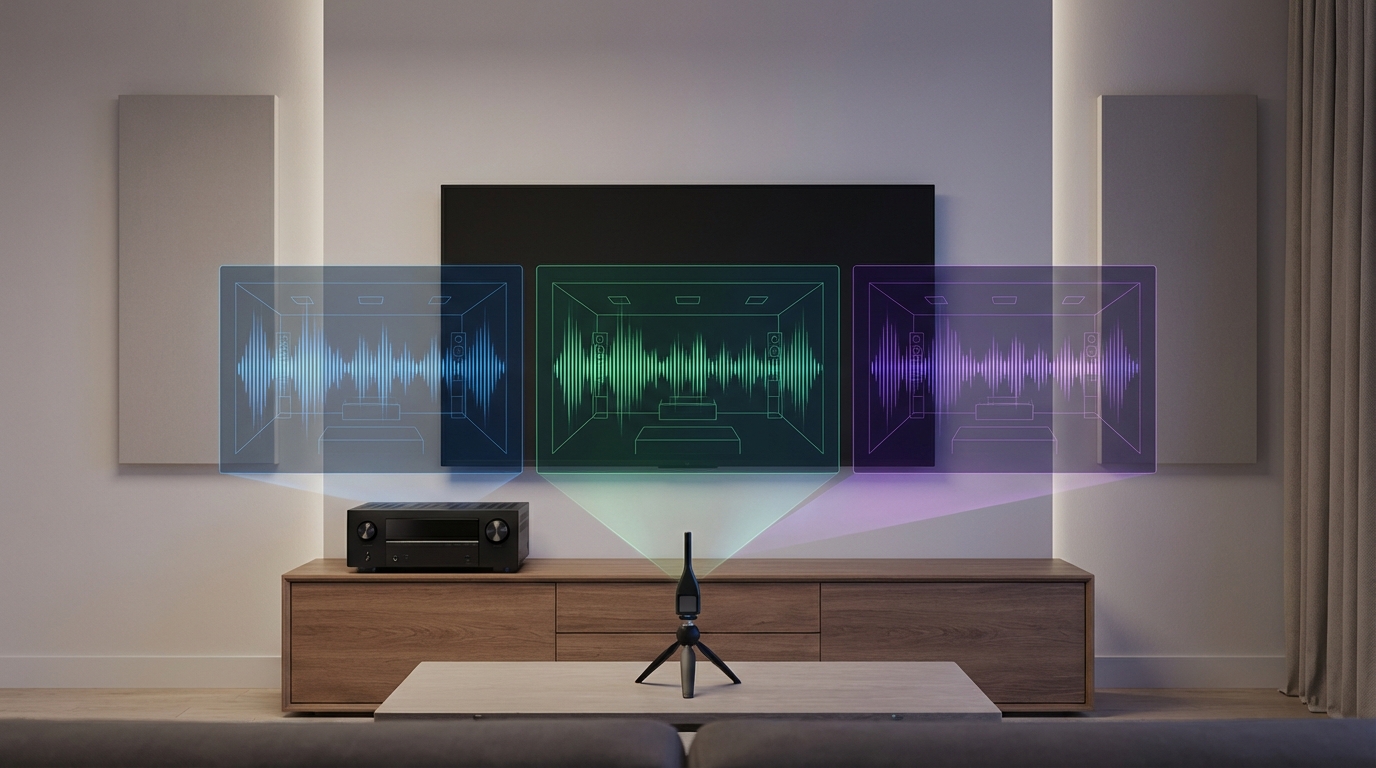
- Run your receiver’s room correction system again to account for the new amplification.
Some receivers automatically detect external amplification and adjust settings. Others require manual configuration. Check your receiver manual for the specific procedure.
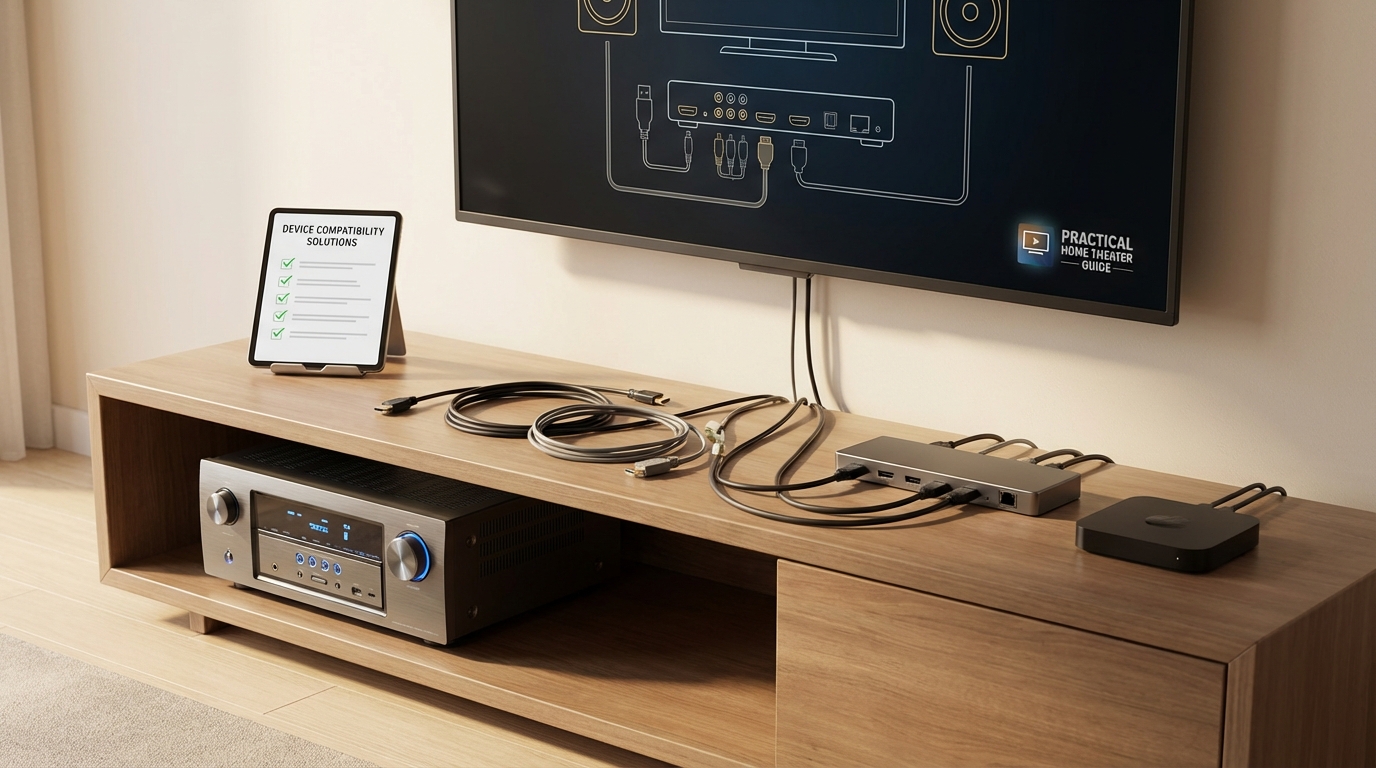
Your complete guide to connecting an AV receiver covers the basics, but external amplification adds another layer of complexity.
Cable quality matters more with external amplification. The signal travels longer distances and through more connections. Use shielded cables to prevent interference and maintain signal integrity.
Budget considerations and realistic expectations
Separate power amplifiers range from $300 entry-level models to $10,000+ reference pieces. Setting a realistic budget based on your actual needs prevents overspending.
Entry-level amplifiers from Emotiva, Monoprice, or similar brands cost $400 to $800 for two to five channels. These provide clean power and solve most amplification problems without breaking the bank.
Mid-range options from Anthem, Parasound, or Rotel run $1,200 to $2,500. They offer better build quality, lower distortion specifications, and more refined sound. The improvement over entry-level amps is real but not dramatic.
High-end amplifiers justify their cost only in reference-quality systems with equally expensive speakers and room treatments. Spending $3,000 on amplification for $1,000 speakers makes no sense.
Your receiver quality matters too. Pairing a $300 receiver with a $2,000 amplifier creates an imbalanced system. The receiver’s preamp section becomes the bottleneck. Consider whether upgrading your receiver makes more sense than adding external amplification.
Alternative solutions before buying an amplifier
Several approaches solve perceived power problems without adding a separate amplifier. Try these first.
Upgrading to more efficient speakers often costs less than adding amplification. Speakers rated at 90 dB sensitivity instead of 86 dB cut your power needs in half. This single change eliminates most power concerns.
Improving room acoustics reduces the volume needed for satisfying playback. Excessive reflections and poor bass response force you to turn up the volume. Adding acoustic treatment lets you hear more detail at lower levels.
Repositioning speakers closer to listening positions reduces power demands significantly. Moving speakers from 15 feet to 10 feet away cuts required power by more than half.
Upgrading your receiver to a model with better amplification often costs less than adding a separate amplifier. Modern mid-range receivers deliver impressive power with better efficiency than older models.
Multi-channel amplification versus stereo amps
You can amplify all channels or just the most demanding ones. Each approach has advantages depending on your situation.
Five-channel amplifiers power your entire front stage plus surrounds. This creates consistent amplification across all channels and simplifies setup. Prices start around $800 for entry-level models.
Stereo amplifiers cost less and let you prioritize your front left and right speakers. You can add a second stereo amp later for the center and surrounds. This staged approach spreads the investment over time.
Three-channel amplifiers target the front stage, which handles most of the workload during movies and music. Your receiver powers the surrounds, which rarely demand high output levels.
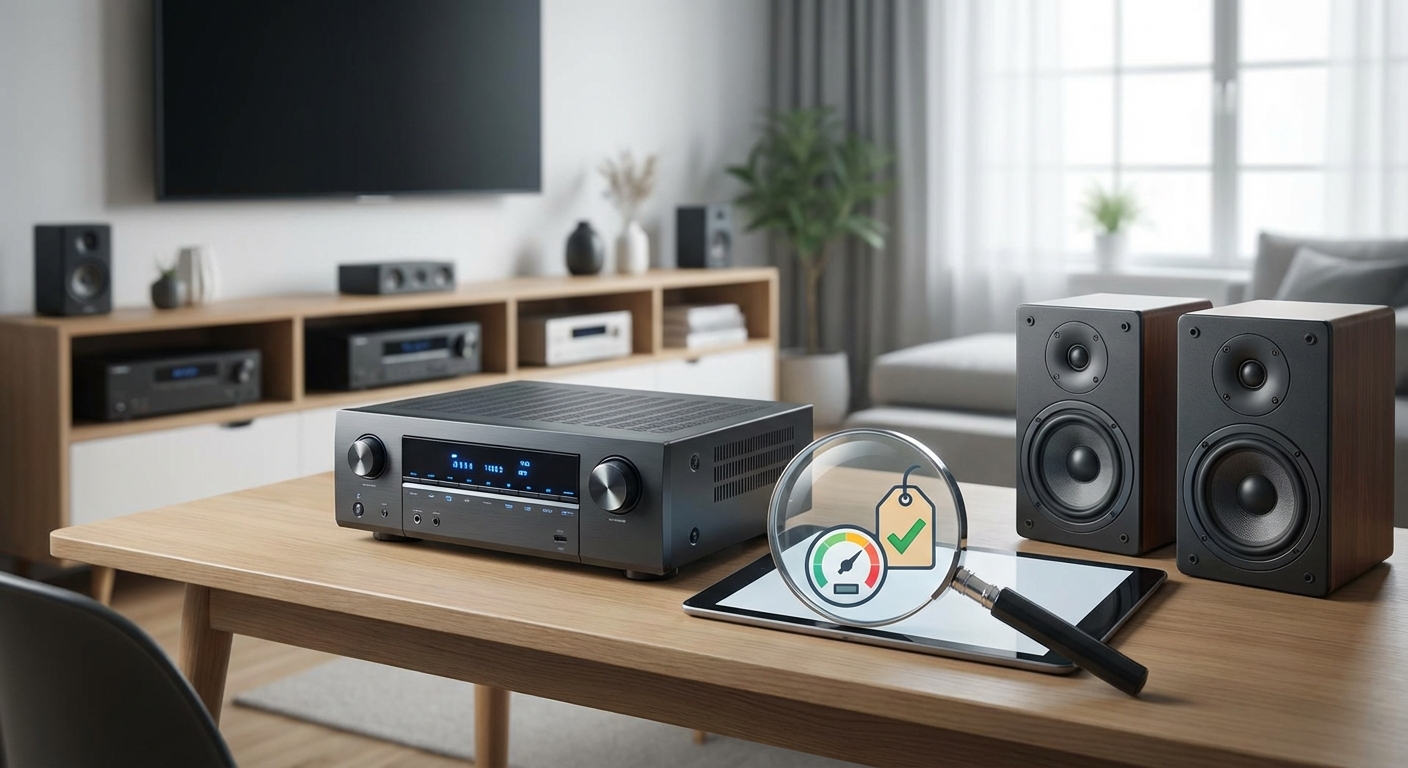
Matching your receiver’s wattage to your speakers helps you decide which channels need external amplification most.
Testing whether external amplification actually helps
Before committing to an amplifier purchase, test whether you’ll hear a meaningful difference. Many retailers offer return periods that let you evaluate performance in your room.
Play reference material that stresses your system. Action movie soundtracks with deep bass and loud peaks reveal amplifier limitations. Concert recordings with wide dynamics show whether you gain headroom.
Listen for specific improvements. Better bass control sounds tighter and more defined. Improved dynamics mean louder peaks without harshness. Reduced distortion creates smoother, more natural sound during complex passages.
Compare carefully at matched volumes. Louder always sounds better, so you must level-match the comparison. Use an SPL meter to ensure identical output levels with and without the external amplifier.
If you cannot hear a clear difference, you don’t need the amplifier. Trust your ears over specifications and marketing claims.
When receiver upgrades make more sense
Sometimes replacing your receiver solves the problem better than adding external amplification. Consider this option if your receiver lacks features or shows its age.
Newer receivers include better room correction, improved video processing, and more flexible streaming options. They also deliver more power with better efficiency than models from five years ago.
A $1,000 receiver upgrade might provide everything you need without the complexity of external amplification. You get more channels, better features, and adequate power in a single box.
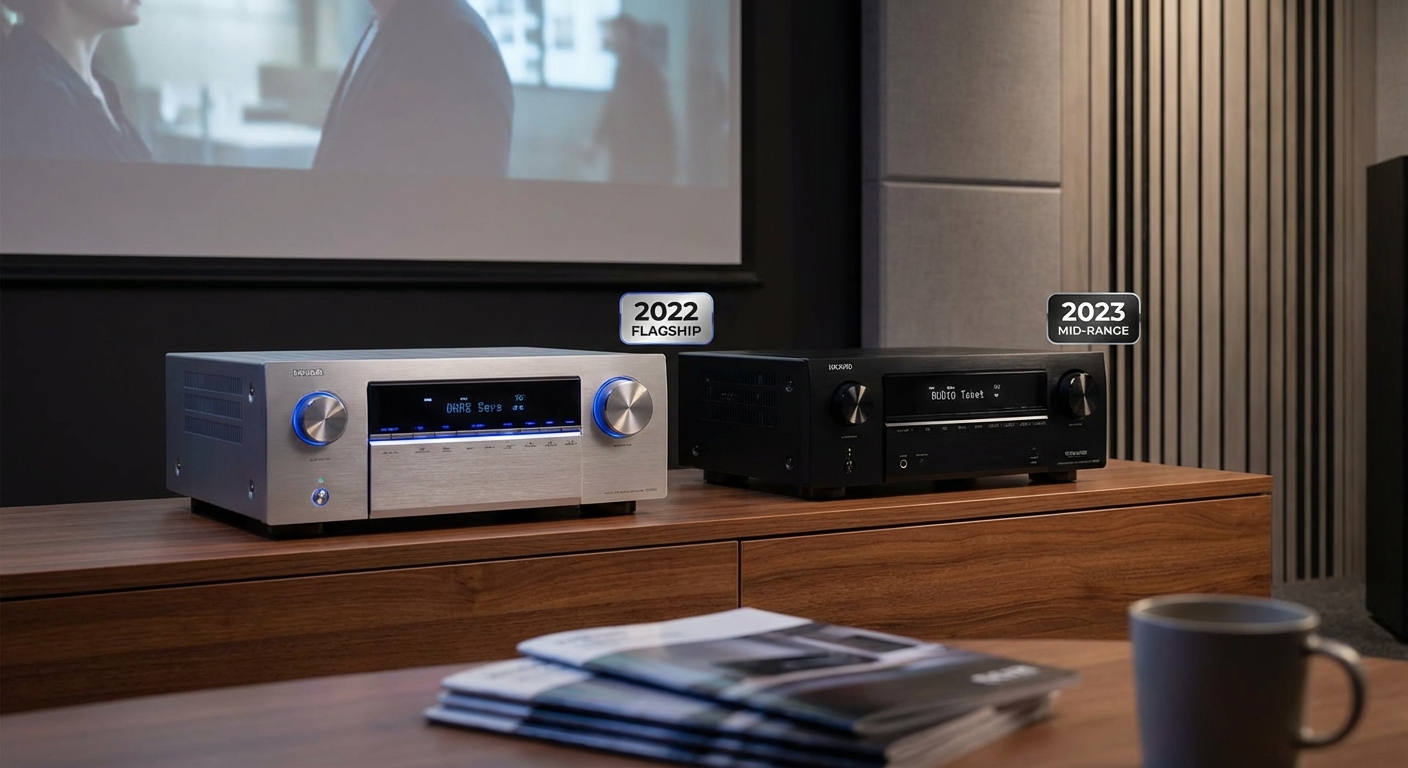
Choosing between last year’s flagship and this year’s mid-range receiver often delivers better value than keeping an old receiver and adding an amplifier.
Making the final decision for your setup
Deciding whether you need a separate power amplifier comes down to honest assessment of your current system’s performance and limitations.
You need external amplification if your receiver shuts down from heat, your speakers sound strained at normal volumes, or you own demanding speakers with low sensitivity ratings. These situations create real performance problems that external amps solve.
You don’t need external amplification if your system plays as loud as you want without distortion, your receiver stays cool during use, and your speakers have sensitivity ratings above 88 dB. Adding an amp in these cases wastes money that could improve other aspects of your theater.
Test your system thoroughly before deciding. Push it hard with demanding content. Note specific problems rather than vague feelings that something might sound better. Real limitations are obvious. Imagined ones disappear under scrutiny.
Your home theater sounds as good as its weakest link. Sometimes that’s amplification. Often it’s room acoustics, speaker placement, or calibration settings. Identify your actual bottleneck before spending money on solutions that don’t address your real problems.

Leave a Reply