
Choosing the right room size for your home theater can make or break your sound quality. Get the dimensions wrong, and you’ll battle boomy bass, dead spots, and muddy dialogue no matter how much money you spend on speakers.
The best room dimensions for home theater follow specific ratios that minimize acoustic problems. Ideal proportions range from 1:1.6:2.6 to 1:1.9:3.1 for height, width, and length. Avoid perfect cubes and rooms where any two dimensions are identical or exact multiples, as these create severe standing waves and bass cancellation that ruin sound quality regardless of equipment.
Why room shape matters more than room size
A small room with good proportions will always sound better than a large room with bad ones.
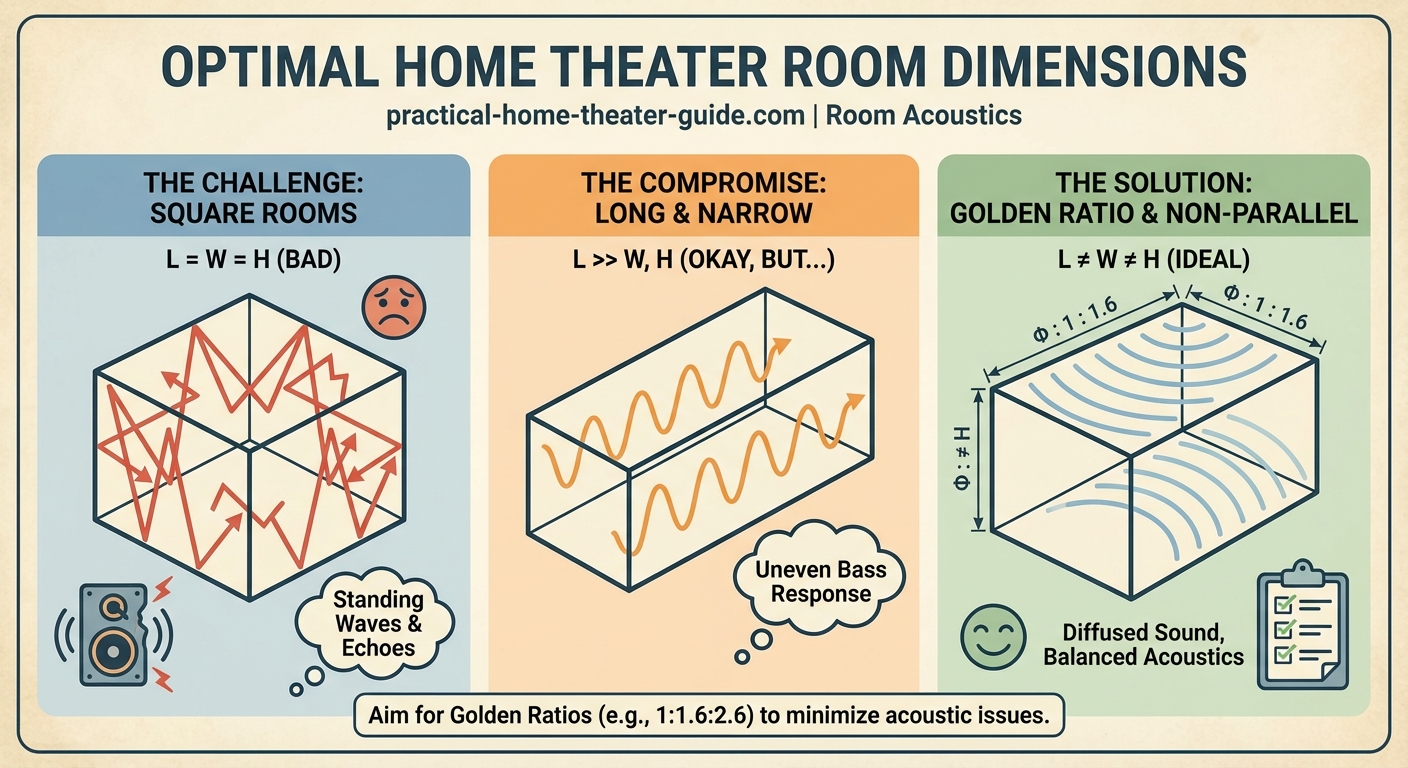
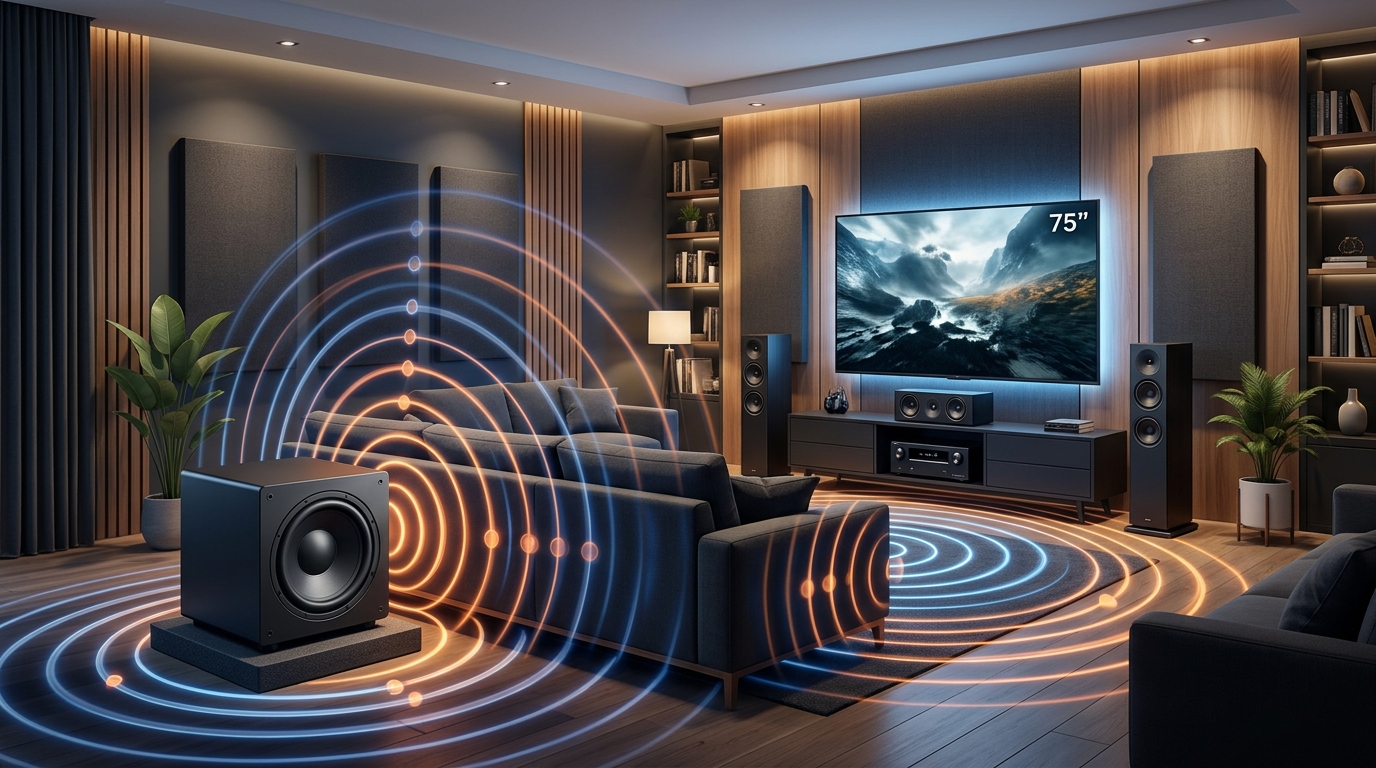
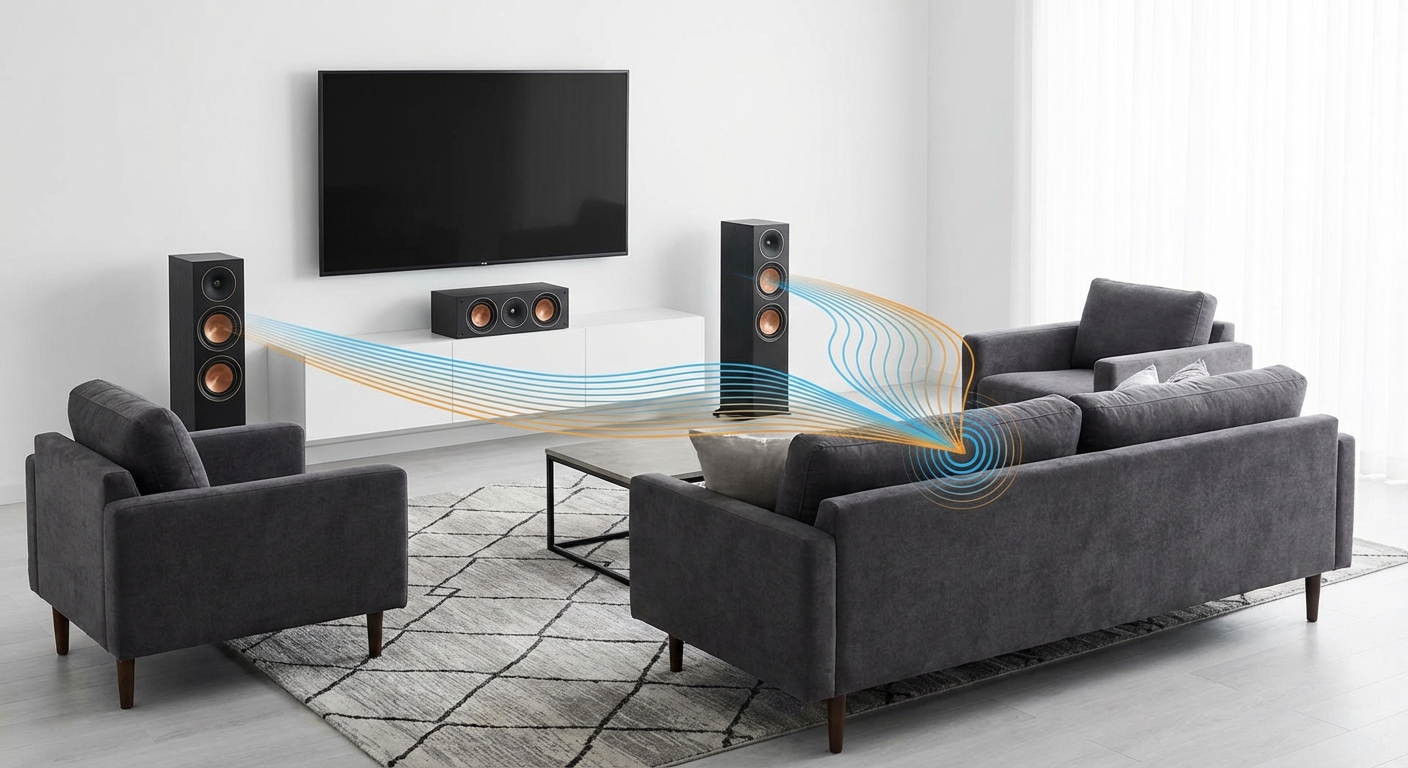
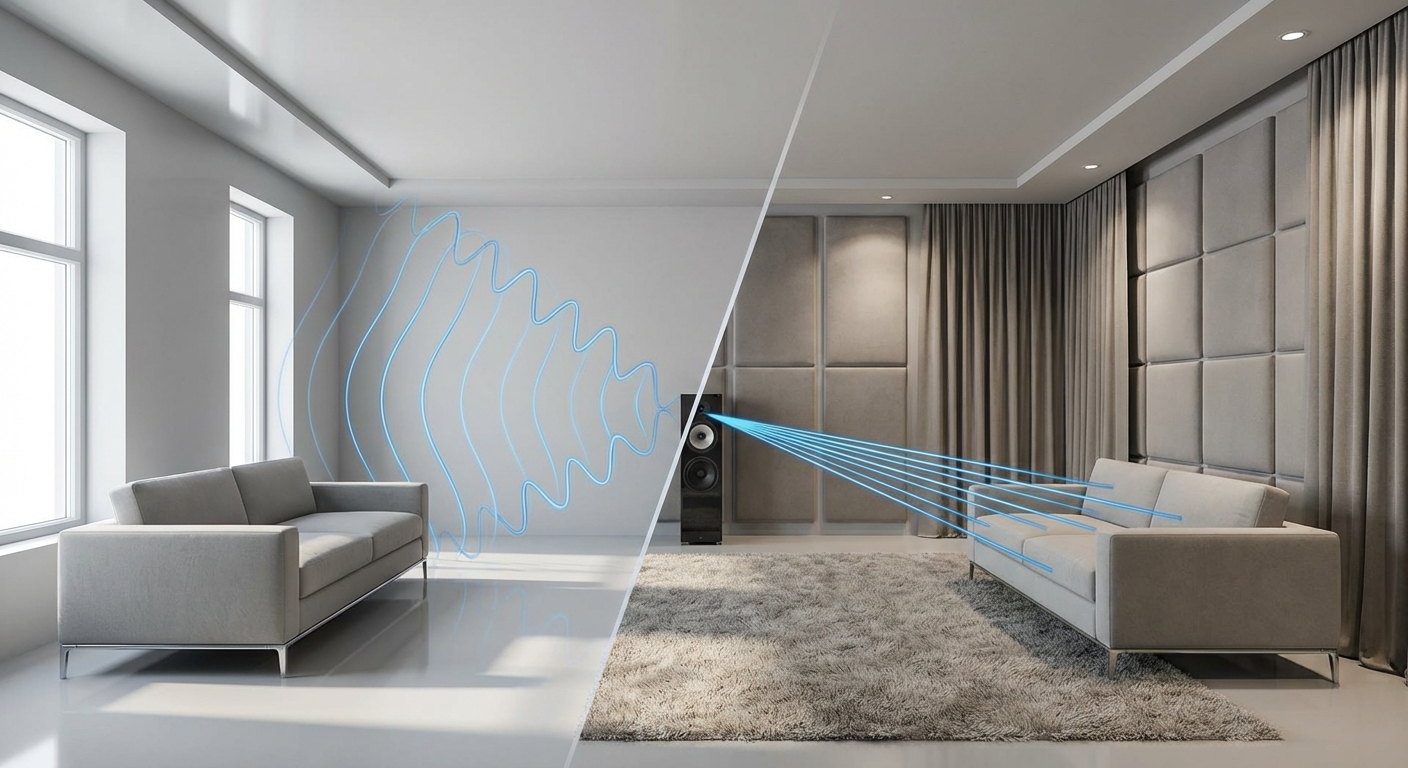
The problem comes down to physics. Sound waves bounce between parallel walls. When the distance between those walls matches certain wavelengths, you get standing waves. These create spots where bass sounds twice as loud and other spots where it disappears completely.
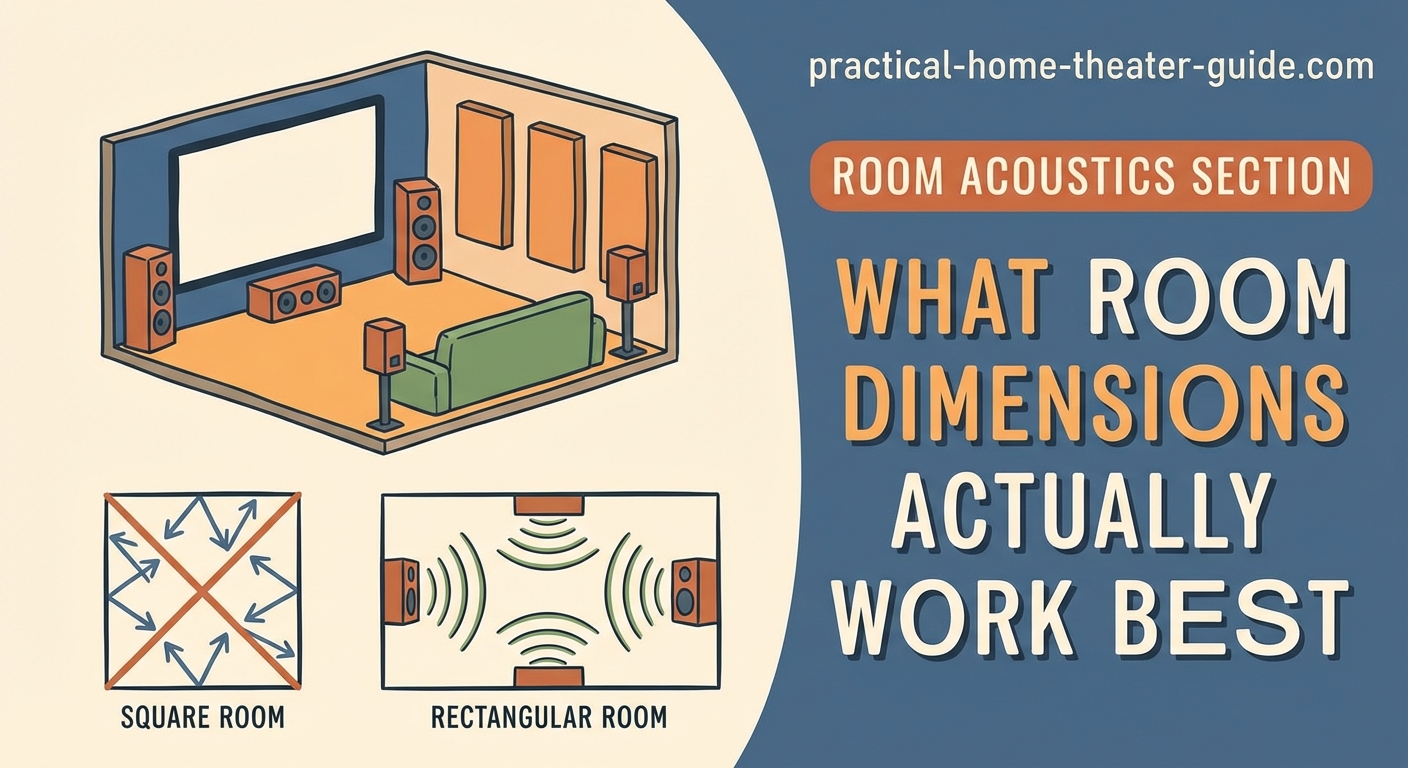
Perfect cubes are the worst offenders. A 12x12x12 room creates identical standing waves in all three dimensions. They stack up at the same frequencies and create massive peaks and nulls.
Rooms where two dimensions match cause similar problems. A 10x10x15 room has all the acoustic issues of a square room, just stretched in one direction.
Proven ratios that actually work
Acousticians have tested thousands of room dimension combinations. Several ratios consistently produce the smoothest frequency response.
The golden ratio (1:1.6:2.6) is the most famous. For a room with 8-foot ceilings, that translates to roughly 13 feet wide and 21 feet long. This spreads standing wave frequencies across the spectrum instead of clustering them.
The Louden ratio (1:1.4:1.9) works well for smaller spaces. With the same 8-foot ceiling, you’d want about 11 feet wide and 15 feet long.
The Sepmeyer ratios offer three options:
– 1:1.14:1.39
– 1:1.28:1.54
– 1:1.60:2.33
Here’s a practical comparison of how these ratios translate to real rooms:
| Ratio Name | Height | Width | Length | Best For |
|---|---|---|---|---|
| Golden (1:1.6:2.6) | 8 ft | 13 ft | 21 ft | Medium to large rooms |
| Louden (1:1.4:1.9) | 8 ft | 11 ft | 15 ft | Compact dedicated theaters |
| Sepmeyer A (1:1.14:1.39) | 8 ft | 9 ft | 11 ft | Small basement conversions |
| Sepmeyer B (1:1.28:1.54) | 8 ft | 10 ft | 12 ft | Spare bedroom theaters |
| Sepmeyer C (1:1.60:2.33) | 8 ft | 13 ft | 19 ft | Rectangular living spaces |
Don’t stress about hitting these numbers exactly. Getting within 10% of any proven ratio gives you most of the benefit.
How to measure and plan your space
Start by measuring what you have or what you can build.
- Measure ceiling height first, as this is usually fixed by your home’s structure.
- Calculate your ideal width by multiplying ceiling height by your chosen ratio’s width factor.
- Calculate ideal length by multiplying ceiling height by the length factor.
- Compare these targets to your available space and adjust as needed.
If your existing room doesn’t match any ratio perfectly, identify which dimension you can modify. Basement theaters often let you frame new walls wherever you want. Bonus rooms might have fixed exterior walls but flexible interior partitions.
“A room that’s 15% off from an ideal ratio still performs vastly better than a square room or one with matched dimensions. Don’t let perfect be the enemy of good.” – Acoustic engineer’s guideline from multiple THX certified installations
When you’re stuck with a less than ideal space, knowing your room’s specific problem frequencies helps you treat them with bass traps and absorption. But starting with good proportions means you need far less treatment later.
What to avoid at all costs
Some dimension combinations create acoustic nightmares that no amount of treatment can fully fix.
Never build or choose:
– Perfect cubes (12x12x12, 15x15x15)
– Rooms where two dimensions match (10x10x18, 14x14x9)
– Rooms where one dimension is exactly double another (10x10x20, 8x16x20)
– Rooms where one dimension is exactly triple another (8x8x24)
These create standing waves that align at the same frequencies. The result is massive 20dB peaks and nulls that make bass sound completely different depending on where you sit.
Long, narrow hallway-shaped rooms also cause problems. Anything with a length more than 3.5 times the width creates a tunnel effect. Reflections bounce back and forth along the length, smearing dialogue clarity.
Very small rooms under 1,500 cubic feet struggle with bass below 40Hz. The wavelengths are simply too long for the space. You can still build a great theater in a small room, but you’ll need to accept limited deep bass extension or add multiple subwoofers with careful placement.
Working with the room you have
Most people can’t build from scratch. You’re working with an existing basement, bedroom, or bonus room.
Measure your current space and calculate its ratios. Divide width by height, then length by height. Compare these to the proven ratios above.
If you’re close to a good ratio, consider minor modifications. Moving one wall by 18 inches might transform an okay room into a great one. This matters most during renovation planning, before drywall goes up.
If your ratios are far off, focus on the worst offenders first. A room that’s 14x14x20 has that problematic 14×14 square base. Even adding 2 feet to one dimension (making it 14x16x20) significantly improves the acoustic behavior.
Angled walls can help break up standing waves, but they create other challenges for speaker placement and treatment. Only consider this if you’re committed to extensive acoustic work.
Ceiling height considerations
Standard 8-foot ceilings work fine for home theater. They’re actually easier to treat acoustically than very tall ceilings.
Taller ceilings (9 to 12 feet) give you more flexibility with ratios and create a more spacious feel. They also push ceiling reflection problems to higher frequencies where absorption is easier and cheaper.
Very low ceilings under 7.5 feet create a cramped feeling and force standing wave problems into higher frequencies where they’re more audible. If you’re finishing a basement with low joists, consider whether the acoustic compromises are worth it.
Cathedral or vaulted ceilings break the simple ratio rules. The varying height means you can’t calculate clean standing wave patterns. Some installers love them for this unpredictability. Others find them harder to treat consistently. If you have a vaulted ceiling room, focus on width to length ratio and add more absorption than a standard room would need.
Practical examples for common spaces
A typical 12×15 bedroom with 8-foot ceilings gives you ratios of 1:1.5:1.875. That’s close to the Sepmeyer B ratio (1:1.28:1.54) when you account for the longer dimension. Not perfect, but workable with some acoustic treatment.
A 15×20 basement room with 8-foot ceilings yields 1:1.875:2.5. This sits between the Golden ratio and Sepmeyer C. Excellent proportions that will sound great with minimal treatment.
A 20×20 bonus room with 9-foot ceilings is 1:2.22:2.22. Those matched width and length dimensions create problems. If you can frame an interior wall to make it 20×17, you get 1:1.89:2.22, which is much better.
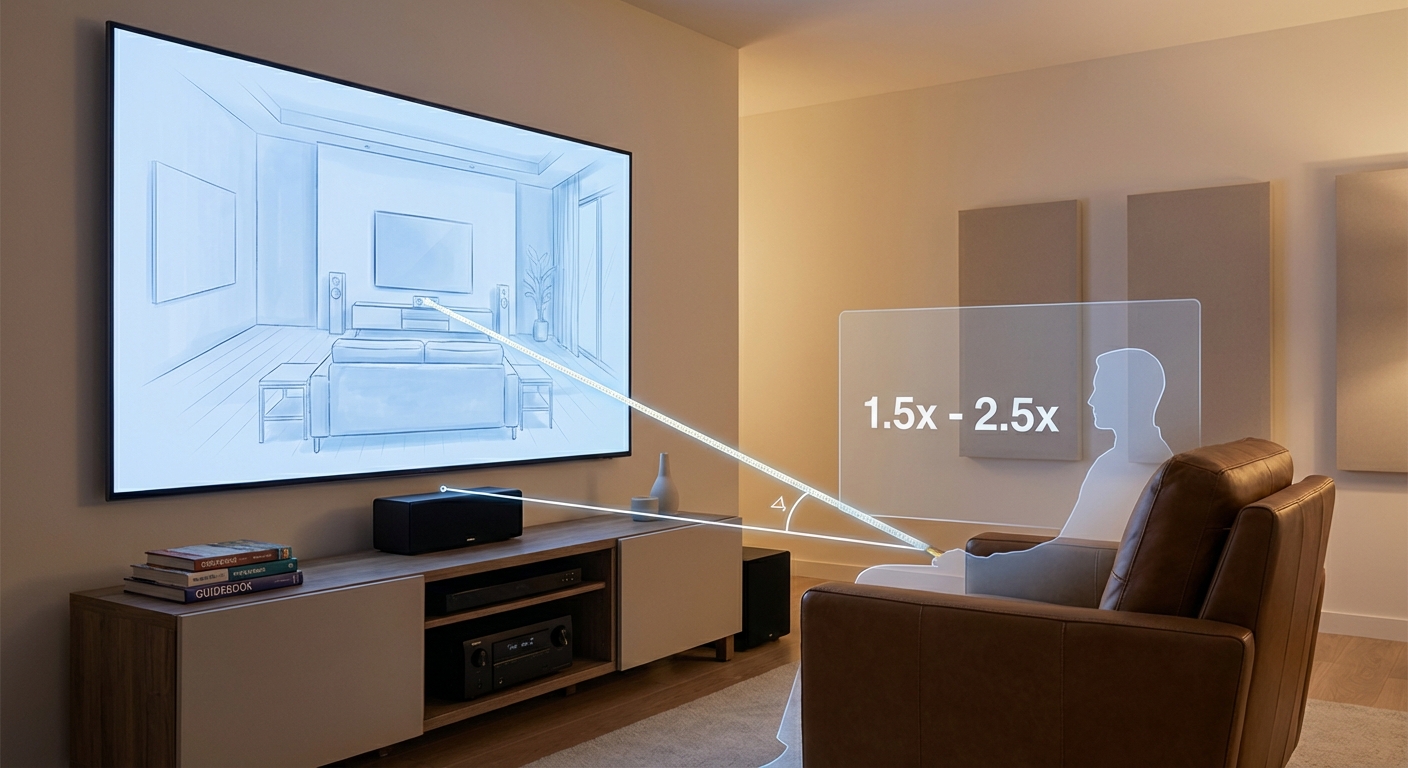
The dimensions you choose also affect your screen size and seating layout. A room that’s acoustically ideal might not fit your desired screen size or number of seats. When planning how to choose the right TV size for your room distance, make sure your acoustic proportions still allow proper viewing distances.
The relationship between volume and bass response
Total room volume affects how low your bass can go before room gain takes over.
Smaller rooms (under 2,000 cubic feet) provide natural bass boost below 60Hz. This sounds impressive at first, but it’s usually uneven and boomy. You’ll need careful subwoofer placement and possibly multiple subs to smooth it out.
Medium rooms (2,000 to 4,000 cubic feet) offer the best balance. You get some room gain to help efficiency without overwhelming boominess. Most dedicated home theaters fall into this range.
Large rooms (over 4,000 cubic feet) need more powerful subwoofers to achieve the same bass levels. But they tend to have smoother, more even bass response with fewer problematic room modes.
Calculate your room volume by multiplying length times width times height. A 13x21x8 room gives you 2,184 cubic feet, right in that sweet spot.
How ratios interact with speaker placement
Good room dimensions make speaker placement much easier.
The front left, center, and right speakers typically go along the short wall. With proper ratios, you have enough width to space them correctly without putting them too close to side walls.
Surround speakers benefit from rooms that aren’t too narrow. The Louden and Golden ratios provide enough width that surrounds can be 2 to 3 feet from side walls, reducing boundary reinforcement issues.
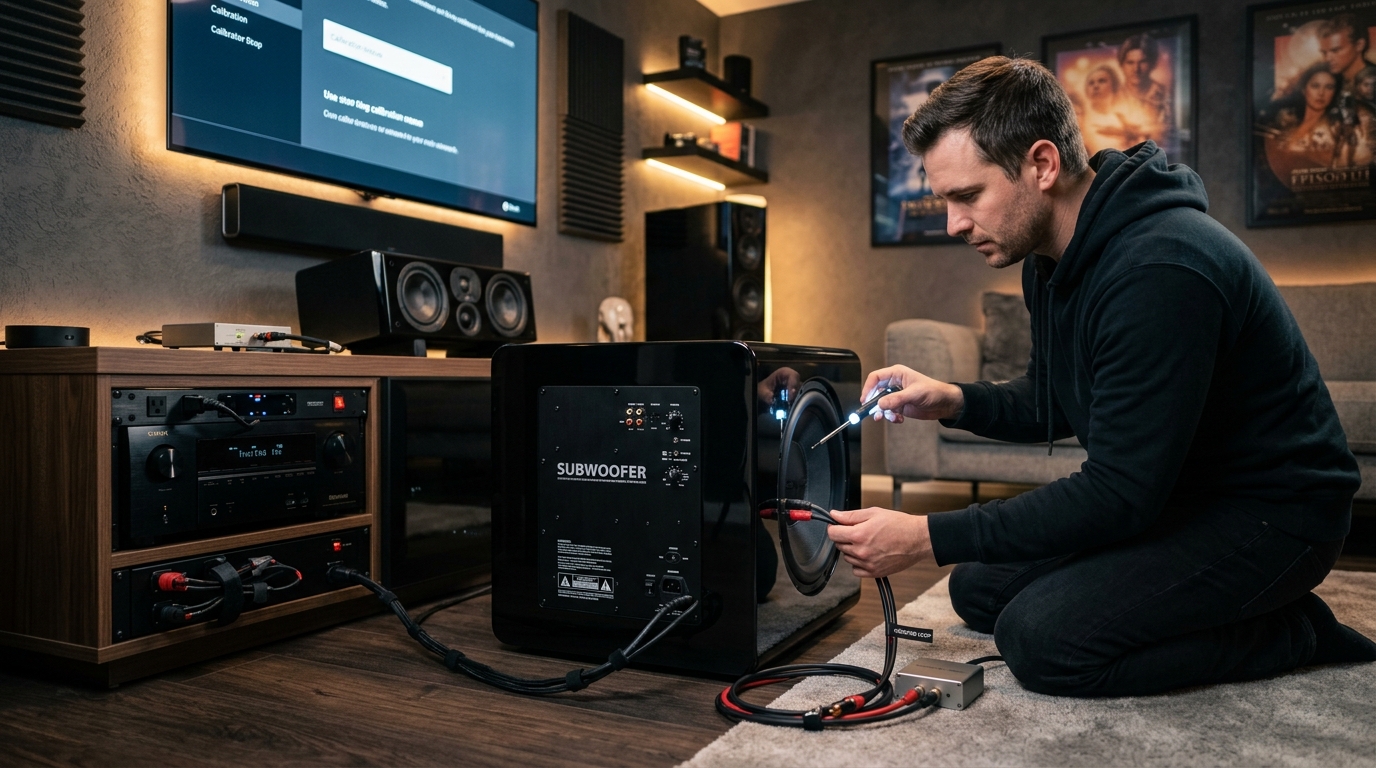
Subwoofer placement is where room dimensions really matter. In a well-proportioned room, you have multiple good subwoofer locations. In a poorly proportioned room, you might have only one spot that works, and it might be exactly where you wanted to put a seat.
When you’re ready to install, knowing how to run speaker wire through walls without damaging your home becomes essential, especially in rooms where optimal speaker positions don’t align with existing wall openings.
Combining dimensions with acoustic treatment
Even perfect dimensions benefit from some acoustic treatment.
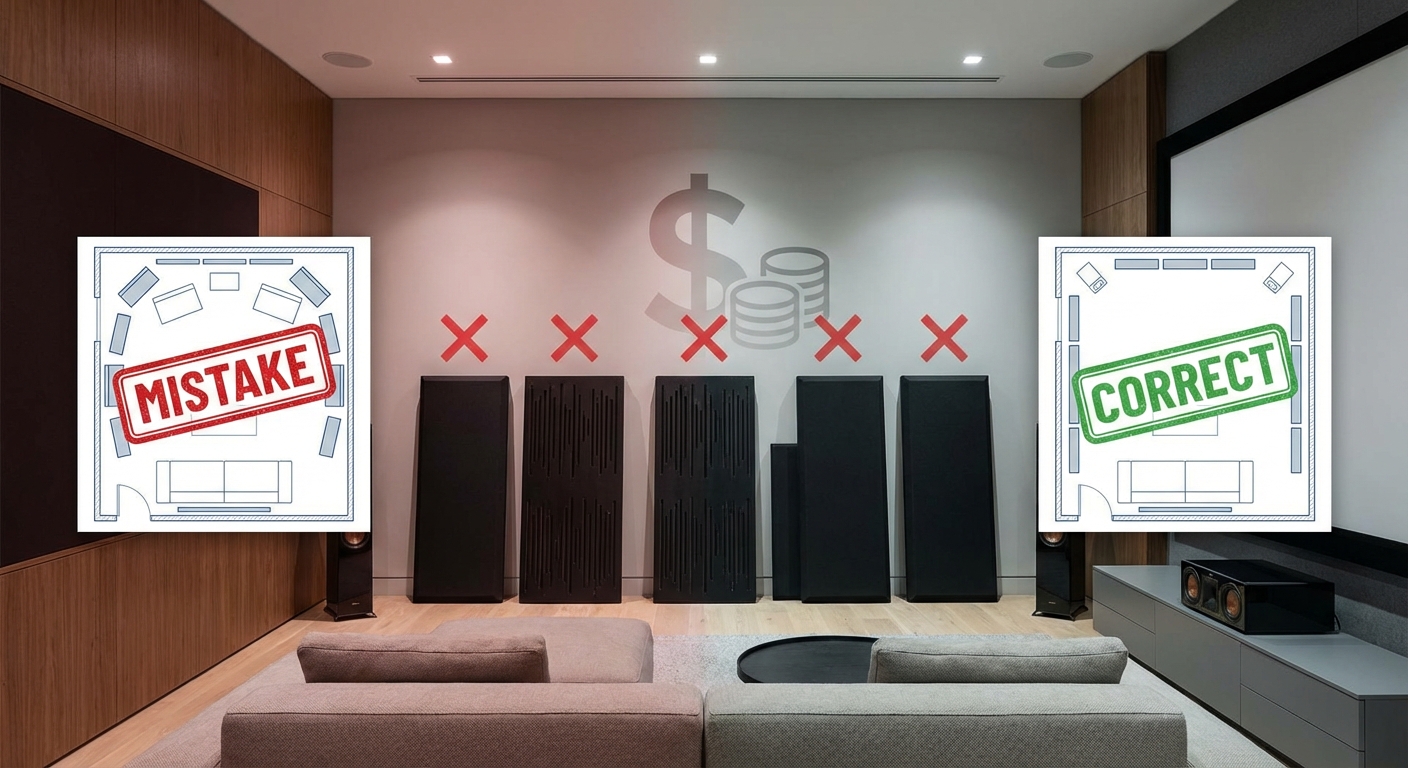
First reflection points on side walls need absorption regardless of room shape. These are the spots where sound bounces directly from speakers to your ears.
Bass traps in corners help smooth out the remaining room modes. Well-proportioned rooms need fewer and smaller bass traps than poorly proportioned ones.
The ceiling benefits from absorption or diffusion to prevent slap echo. This applies to any room size or shape.
Rear wall treatment depends on room length. Shorter rooms need more absorption to prevent early reflections. Longer rooms can use diffusion to add spaciousness without deadening the sound.
If your room has echo or reverb problems that treatment alone can’t solve, check out how to stop echo and reverb ruining your home theater sound for additional strategies.
When to compromise on dimensions
Sometimes you can’t hit ideal ratios. Maybe you’re converting an existing room with immovable walls. Maybe your only available space is oddly shaped.
Prioritize avoiding the worst dimension combinations over achieving perfect ratios. A room that’s 14x16x19 isn’t ideal, but it’s infinitely better than 14x14x19.
If you must choose between room size and room ratio, lean toward better ratios in smaller spaces rather than poor ratios in larger ones. A 10x11x15 room with decent proportions will sound better than a 15x15x20 room with matched dimensions.
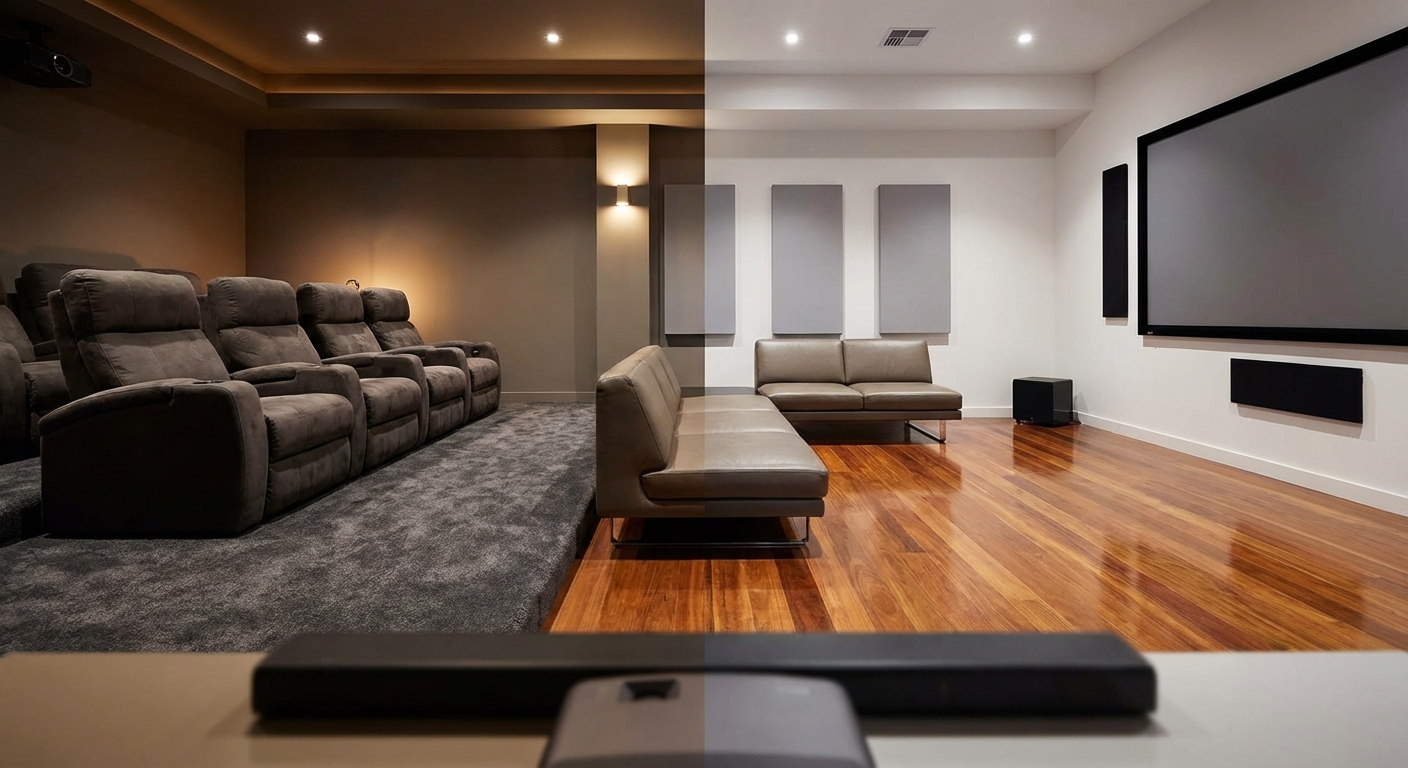
Consider whether you’re building a dedicated theater or a multipurpose room. Dedicated theaters justify more extreme dimension optimization. Multipurpose rooms need to balance acoustics with furniture placement, traffic flow, and other uses.
Building new versus modifying existing
New construction gives you complete control over dimensions.
Work with your builder or architect early. Show them your target ratios before framing begins. Moving a wall location by 2 feet costs almost nothing during framing but thousands after drywall is installed.
Communicate that these dimensions matter for acoustics, not just aesthetics. Some builders assume any rectangular room works fine and might “correct” your measurements to something they consider more standard.
Get the dimensions written into your plans. Verify them when framing is complete, before insulation and drywall go up.
For existing rooms, measure carefully and calculate whether modifications make sense. Adding or moving one wall might be worth it. Changing multiple walls probably isn’t unless you’re doing a complete gut renovation anyway.
Making the most of challenging spaces
Some rooms will never have ideal dimensions. That doesn’t mean you can’t build a great theater.
Focus on what you can control. Add more acoustic treatment. Use multiple subwoofers with DSP to smooth bass response. Position your main seating in the best acoustic location, even if that’s not centered in the room.
Asymmetrical room shapes can actually help. An alcove or offset wall breaks up standing wave patterns. Just make sure it doesn’t create new problems like flutter echo between parallel surfaces.
Rooms with openings (doorways, half walls, open floor plans) don’t follow simple ratio rules. The acoustic space extends beyond the visible room boundaries. These spaces often need professional acoustic analysis to optimize.
If you’re using a projector in a non-ideal room, at least make sure how to calculate projector throw distance for your room size works with your available dimensions, so video quality doesn’t suffer along with audio.
Measuring your results
After you’ve built or chosen your room, verify the acoustic performance.
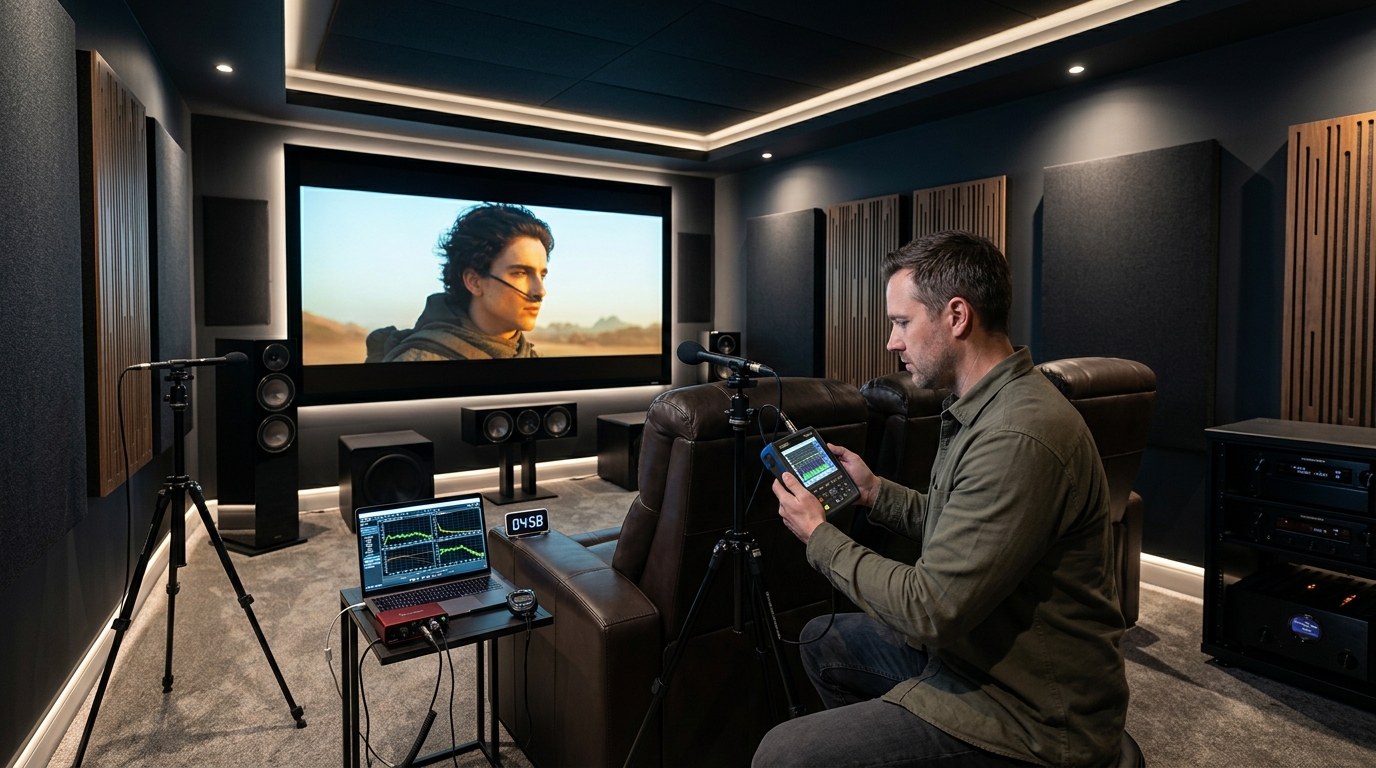
Play test tones from 20Hz to 200Hz in 5Hz increments. Walk around the room and listen for spots where bass gets much louder or disappears. Well-proportioned rooms have gentler variations.
Use a measurement microphone and room correction software if you want detailed data. Free tools like REW (Room EQ Wizard) show you exactly which frequencies have problems and how severe they are.
Compare your measurements to rooms with known good and bad dimensions. This helps you understand whether your remaining issues are normal (every room has some modes) or severe (indicating dimension problems).
Don’t expect perfection. Even professionally designed studios have some room modes. The goal is manageable problems that treatment and DSP can address, not zero problems.
Planning for future flexibility
Room dimensions are permanent, but everything else can change.
Choose dimensions that work across different equipment configurations. You might start with a 5.1 system and upgrade to 7.2.4 later. Good proportions help both setups.
Leave space for acoustic treatment you might add later. A room with ideal dimensions but zero clearance for bass traps isn’t actually ideal.
Consider resale value if this isn’t your forever home. Buyers might not care about acoustic ratios, but they will notice if the room feels oddly proportioned or sounds echoey during a showing.
Document your room dimensions and ratios. Future you (or future owners) will appreciate knowing why the room was built this way when they’re planning upgrades or modifications.
Getting your room dimensions right from the start
The best room dimensions for home theater follow proven acoustic ratios that spread standing waves across the frequency spectrum.
Measure your available space. Calculate which proven ratio fits best. Avoid matched dimensions and simple multiples. Make modifications during construction when walls are easy to move.
Your room’s proportions affect everything else you do. Great dimensions make speaker placement easier, reduce treatment needs, and ensure your system sounds its best everywhere in the room.
Take the time to get this right. It’s the one thing you can’t easily fix later with better equipment or more treatment.

Leave a Reply