You just unboxed a new set of speakers. They look great, feel solid, and you can't wait to hear how they sound with your favorite movie. But then you look at the back of your amplifier and see a confusing set of numbers: 8 ohms, 4 ohms, 100 watts per channel. You start wondering if you're about to blow something up. Relax, you're not alone, and it's way easier than it looks. Matching speaker impedance and amplifier power is one of the most important steps in building a home theater that sounds fantastic and stays reliable. Get it right, and your system will play cleanly for years. Get it wrong, and you might be shopping for a new receiver or a new set of speakers much sooner than you planned.

<div style="border:1px solid #c8b88a; background:#fbf7ea; padding:20px; border-radius:14px; margin-bottom:30px;">
  <div style="font-weight:700; margin-bottom:10px; color:#856404;">Key Takeaway</div>
  <p style="margin:0;">To match speaker impedance and amplifier power safely, always choose speakers with an impedance rating equal to or higher than your amplifier's minimum rating. For power, pick an amplifier that delivers at least the speaker's recommended wattage range, but avoid sending a clipped signal by turning the volume too high. A receiver with a 4 ohm rating can run 8 ohm speakers easily, but the opposite can cause overheating. Check your speaker's sensitivity too, it affects how much power you actually need. When in doubt, go with a slightly more powerful amp.</p>
</div>

## What Is Impedance and Why Should You Care?

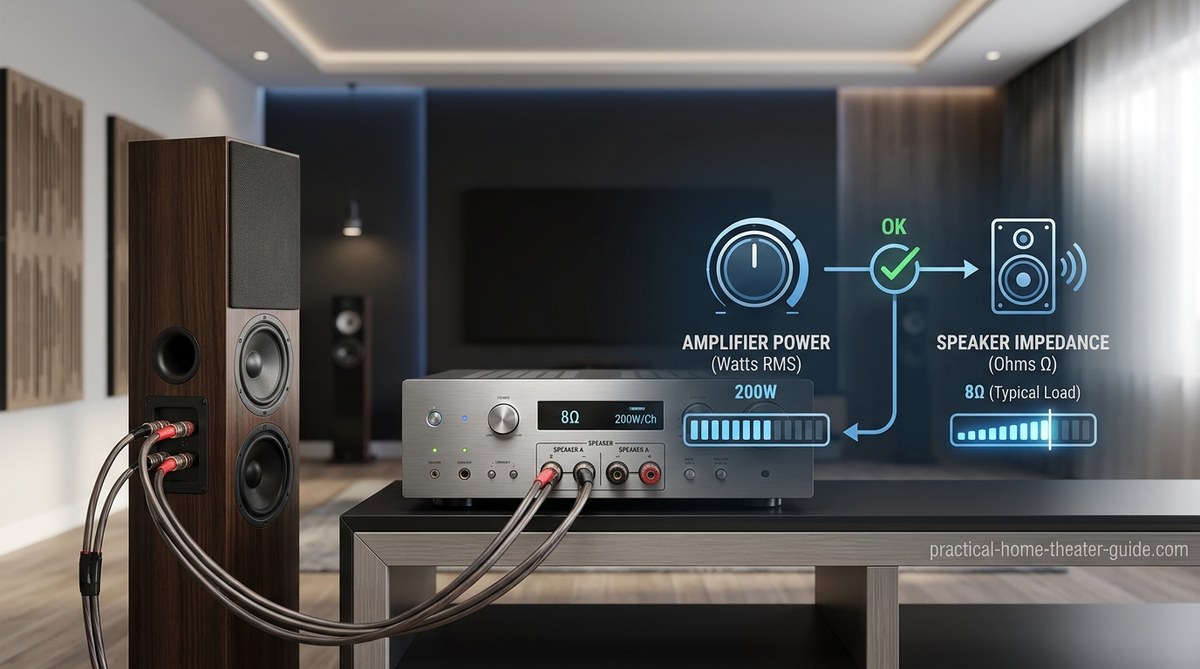
Impedance, measured in ohms, is basically how much your speakers resist the electrical current coming from your amplifier. Think of it like a drinking straw. A low impedance speaker (say 4 ohms) is like a wide straw, it lets a lot of current flow. A high impedance speaker (say 8 ohms) is like a narrower straw, it restricts the flow. Your amplifier has to work harder to push current through a low impedance load. If the impedance drops too low for your amp to handle, the amp can overheat, distort, or even shut down.

Most home theater speakers have a nominal impedance of 4, 6, or 8 ohms. Most AV receivers are designed to drive 8 ohm speakers comfortably. Many can handle 6 ohms, but you have to check the fine print. If you plan to run 4 ohm speakers, you need a receiver that's specifically rated for 4 ohm loads. Ignoring this is the fastest way to hear that unpleasant smell of burning electronics.

## Understanding Amplifier Power Ratings

Amplifier power is measured in watts per channel (WPC). But here's where it gets tricky: that rating is usually given at a specific impedance, typically 8 ohms. A receiver might say "100 watts per channel into 8 ohms." That same receiver will produce more power into a lower impedance load, maybe 150 watts into 4 ohms. But it also has to deliver more current, which generates more heat. That's why impedance matching is so critical.

You also need to pay attention to the speaker's power handling. That's the range of wattage the speaker can safely accept, for example "20 to 150 watts." Your goal is to pick an amplifier that falls within that range. A common mistake is buying an amp that's too weak. A weak amp pushed into distortion (clipping) can damage your tweeters faster than a powerful amp running cleanly. So don't be afraid of a little extra power, just keep the volume knob reasonable.

## The Golden Rule of Matching

Here's the single most important thing to remember: **your amplifier's impedance rating must be equal to or lower than your speaker's impedance.** If your amp is rated for 8 ohms minimum, you can safely use 8 ohm speakers or higher (like 16 ohms, though rare). You should not use 4 ohm speakers with an 8 ohm rated amp unless the amp explicitly states it's stable down to 4 ohms. Some receivers have a switch or menu setting to handle lower impedance, but it often reduces power to protect the amp. Check your manual.

Similarly, the amplifier's power output should not exceed the speaker's power handling by too wide a margin. If your speakers are rated for 100 watts max and you hook them up to a 300 watt amp, one accidental twist of the volume knob can send them to an early grave. Conversely, if your amp is only 20 watts and your speakers need 50 watts minimum, you'll likely drive the amp into distortion trying to get decent volume.

## Common Matching Mistakes: A Handy Table

| Mistake | What Happens | How to Fix |
|---------|--------------|------------|
| Using 4 ohm speakers with an 8 ohm rated receiver | Amplifier overheats, shuts down, or distorts; possible damage to output transistors | Either upgrade to a receiver rated for 4 ohms or swap to 8 ohm speakers |
| Underpowering speakers (amp too weak) | Clipping distorts the audio signal, sending high frequency energy that can blow tweeters | Use an amp that delivers at least the speaker's recommended minimum wattage |
| Overpowering speakers (amp too strong) | Can blow woofers or damage voice coils if volume is cranked carelessly | Keep volume at reasonable levels; use the amp's power only as headroom, not as an excuse to max out |
| Mixing different impedance speakers on the same channel | Uneven volume and possible strain on the amp; most common in stereo or bi-wired setups | Match impedance for all speakers on a given channel; use series/parallel wiring carefully |
| Ignoring sensitivity ratings | High sensitivity speakers need less power to sound loud; low sensitivity speakers need more power, which can stress a weak amp | Calculate actual power need using the sensitivity and desired listening distance |

## Step-by-Step Matching Process

Follow these steps to make sure your setup is safe and sounds its best.

1. **Check your amplifier's specifications.** Find the rated output power per channel at a given impedance (e.g., 80W x 2 into 8 ohms). Also find the minimum impedance rating (e.g., 6 ohms or 4 ohms). This information is usually on the back panel or in the manual.

2. **Check your speaker's nominal impedance.** It's printed on the back of the speaker near the terminals. It will be something like 4 ohms, 6 ohms, or 8 ohms. Also check the recommended amplifier power range.

3. **Verify impedance compatibility.** Your speaker's impedance must be equal to or greater than your amplifier's minimum impedance rating. For example, if your amp says 4 ohms minimum, you can use 4, 6, or 8 ohm speakers. If your amp says 8 ohms minimum, only use 8 ohm (or higher) speakers.

4. **Verify power compatibility.** The amplifier's continuous power output (RMS) should fall within the speaker's recommended power range. If the range is 20-100 watts, an 80 watt per channel amp is perfect. A 120 watt amp is fine too, just don't push it to the limit.

5. **Think about your listening habits.** If you like to watch action movies at reference levels, you need more headroom. A moderately powerful amp (like 100 watts) is usually enough for most home theaters with 8 ohm speakers and average sensitivity (88-90 dB). If your speakers are less sensitive (85 dB or lower), you'll need more power.

6. **Consider using a dedicated power amplifier** if your AV receiver struggles with your speakers. This is common when running multiple low impedance channels or when you have a large room. [Learn more about whether you need a separate power amplifier](https://practical-home-theater-guide.com/do-i-need-a-separate-power-amplifier-for-my-home-theater/).

## Important Safety Tips (Bulleted List)

- Always keep the total impedance load per channel above the amplifier's minimum. For two speakers wired in parallel (common on some receivers), the combined impedance drops. Example: two 8 ohm speakers in parallel = 4 ohms. Make sure your receiver can handle that.
- Never use speakers with a lower impedance than your receiver's rating. The receiver will try to deliver too much current and may overheat.
- Give your amplifier plenty of ventilation. A hot amp is more likely to clip or shut down.
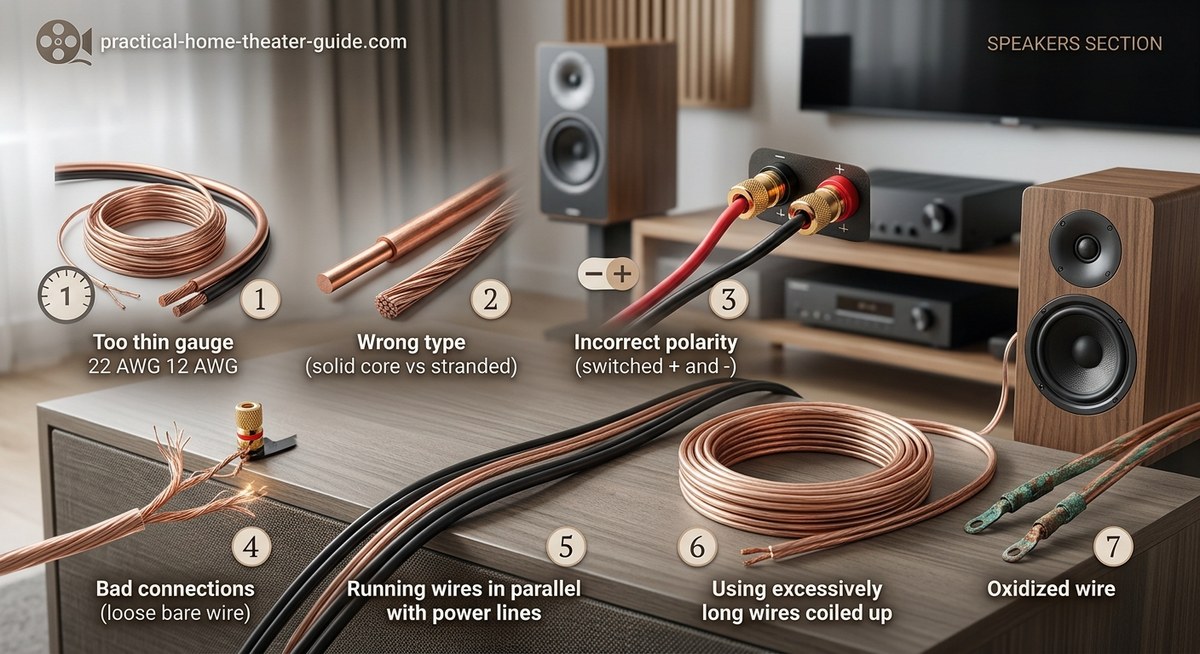
- Use quality speaker wire. Thin wire increases resistance, which can throw off impedance calculations and waste power.
- If your receiver shuts off after a few minutes of loud playback, you're likely overworking it. Back off the volume or upgrade your gear.
- Avoid "A+B" speaker modes unless your receiver is rated for low impedance loads. Many receivers warn against running two sets of speakers at the same time.

> **Expert Advice:** "Matching impedance is the first rule of safe audio. I always tell people to buy an amplifier that is stable at half the impedance of their speakers. If you have 8 ohm speakers, get one rated for 4 ohms. That gives you headroom and ensures the amp stays cool even during dynamic peaks. Power wise, a little extra is fine, just don't drive it into clipping. Clipping is what kills speakers, not clean power." - Mark Reynolds, home theater installer with 20 years of experience.

## What Happens When You Mismatch?

If you connect a 4 ohm speaker to an 8 ohm rated receiver, the receiver will try to supply more current than it's designed for. It will run hot, the protection circuit may kick in, and you might hear distortion before it shuts down. Prolonged use can damage the amplifier's output stage.

If you connect a very powerful amp to weak speakers and you crank the volume, the speakers can mechanically fail. The cone may bottom out, or the voice coil can overheat and melt. On the flip side, a weak amp pushed to its limit sends a clipped square wave to the speakers, which contains high frequency energy that destroys tweeters.

Both scenarios are bad, but they are entirely avoidable with a little planning. If you already have a system that feels mismatched, check out our guide on [how to match your receiver's wattage to your speakers without overspending](https://practical-home-theater-guide.com/how-to-match-your-receivers-wattage-to-your-speakers-without-overspending/) for budget friendly solutions.

## Your Safe Setup Checklist

Before you hit play on that action blockbuster, run through this checklist:

- [ ] Speaker impedance is equal to or higher than the amplifier's minimum rating.
- [ ] Amplifier power output (RMS) is within the speaker's recommended range.
- [ ] Speaker wire gauge is appropriate for the distance (16 gauge for runs under 50 feet, 14 gauge for longer runs).
- [ ] Amplifier has room to breathe, not crammed in a tight cabinet.
- [ ] Volume is turned down before first power on. Gradually increase to a normal listening level.
- [ ] If you hear distortion or see the receiver getting unusually hot, stop and reassess.

If you follow these steps, you can enjoy your home theater for years without a single incident. Impedance and power matching isn't magic, it's just a few simple numbers. Once you get comfortable, you can even experiment with different speaker brands and power configurations. Just keep the math in mind, and your ears will thank you.

And if you're still in the shopping phase, take a look at some proven [budget bookshelf speakers that sound like they cost twice as much](https://practical-home-theater-guide.com/5-budget-bookshelf-speakers-that-sound-like-they-cost-twice-as-much/) or read up on [why your new AVR keeps shutting off and how to fix it](https://practical-home-theater-guide.com/why-your-new-avr-keeps-shutting-off-and-how-to-fix-it/) before you buy.

Setting up a home theater should be exciting, not stressful. Now you know exactly how to match speaker impedance and amplifier power without blowing anything up. Go ahead, hook it up, and enjoy the show.


Leave a Reply